The government shutdown is here. This crisis has been coming for a long time. Congressional Democrats have been spoiling for a fight with the Trump Administration for months and this funding crisis represents one of the few times that Senate rules have provided them with real leverage. Additionally, House and Senate appropriators spent the spring and summer producing different versions of the 12 fiscal year 2026 government spending bills that vary greatly in terms of overall spending and policy. This has made it impossible to negotiate and pass any of them before the fiscal year deadline.
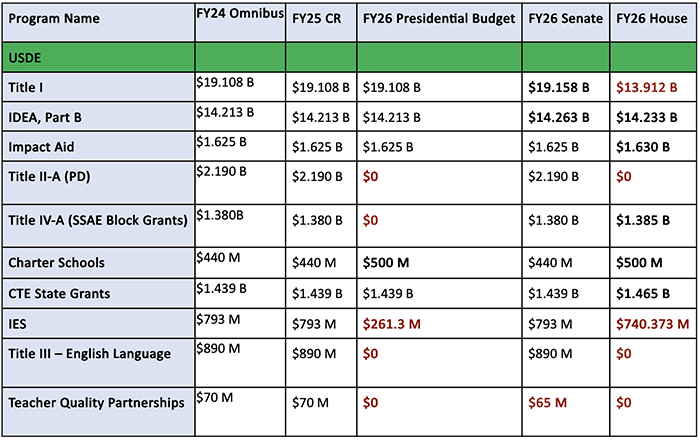
The FY26 Labor HHS Education spending bills approved by each chamber’s Appropriations Committee is, unfortunately, a good example of the problem. The House version would slash $12 billion from the Department of Education, a 15% cut overall, and would make dramatic spending cuts in key K-12 education programs to pay for those cuts. The $2.1 billion Title II-A professional development formula grant and the $890 million Title III English Language Acquisition program would be eliminated entirely while Title I, the largest K-12 program, would sustain a more than 25% cut. The Senate bill, by contrast, would largely level-fund the Department, increase Title I and IDEA, and maintain spending for Title II-A and Title III. It also would include language designed to prevent the Department from delaying state formula grant allocations, as it did in July when it withheld $7 billion in K-12 spending.
Here is a breakdown of how the bills and the President’s budget match up:
There are significant concerns about the ramifications from the shutdown. For one thing, the Office of Management and Budget had threatened that federal employees would not just be furloughed but could actually be fired. [It is worth noting that the Department of Education’s shutdown plan does not indicate that layoffs will occur.] For another, there remains a possibility that the second tranche of FY25 K-12 formula funds, including two-thirds of Title II-A dollars, may not be allocated on October 3rd.
Meanwhile, as Congress grapples with funding for FY26, some FY25 dollars remain at stake. The Department of Education has elected to cancel a number of competitive grant programs, including in Title III for EL educator professional development, and redirect those dollars to other Administration priorities, including charter schools. The Administration claims that it has authority to make these shifts based on loose language in the FY25 full year Continuing Resolution that Congress approved in March. These abrupt cancellations of grants, some of which are for the third or fourth year of multi-year grants, have sown great confusion in the K-12 community.
FCC eliminates E-Rate eligibility for Wi-Fi hotspots and Wi-Fi on school buses
On September 30th, the Federal Communications Commission (FCC) voted 2-1 to reverse decisions made in the past two years that allowed schools and libraries to receive E-Rate support for purchasing Wi-Fi hot spots for student and library patron home use and Wi-Fi on school buses.
FCC Chairman Brendan Carr justified the Wi-Fi on school buses decision by stating:
“The Declaratory Ruling adopted today finds that funding Wi-Fi on school buses both exceeds the FCC’s statutory authority and does not promote sound policy choices. The agency determined that the best reading of section 254 of the Communications Act of 1934, is that the use and provision of these services on school buses does not serve an “educational purpose” as defined by E-Rate program rules and conflicts with the statute’s direction to enhance access to E-Rate-eligible services for classrooms and libraries.
“Further, E-Rate funding for the use of Wi-Fi hotspots off-campus is inconsistent with the statutory authority provided to the Commission by Congress. Through today’s action, the Universal Service Administrative Company will be directed to deny year 2025 pending funding requests for E-Rate funds to support the use of Wi-Fi on school buses.”
The press release issued by the FCC on Wi-Fi hotspots contains similar reasoning.
The lone Democratic FCC Commissioner Anna Gomez dissented from both decisions, objecting to the overly quick process which allowed for no public input as well as to the policy results, which will negatively impact low-income and rural students and library patrons who lack home broadband access.
While this decision is painful for E-Rate advocates, it does have the virtue of allowing a differently constituted FCC to revisit this issue in the future and reinstate off-campus eligibility. That is far better than the alternative offered by a Senate-passed Congressional Review Act Resolution, which would have not only removed E-Rate eligibility for Wi-Fi hotspots and Wi-Fi on school buses but also prevented the Commission from regulating in this area again. The House has yet to take up this resolution and may not do so now that the FCC has acted.