
According to Results from TALIS 2024: The State of Teaching, from The Organisation for Economic Co-operation and Development, nine in 10 teachers report being satisfied with their jobs overall, and almost three-quarters would choose to work as a teacher again if they had the option to do so. Yet, 27% of novice teachers, on average, report they intend to leave teaching in the next five years. There is no statistical difference in responses regarding job satisfaction between novice teachers and experienced teachers. Novice teachers report they struggle more with classroom management than their more-experienced peers, and in certain education systems are disproportionately assigned to work in the most-demanding classroom environments.
The Teaching and Learning International Survey (TALIS) provides internationally comparable data from the responses of 280,000 lower secondary teachers in 55 education systems across the globe. TALIS 2024 addressed teachers’ working conditions, professional development, and examined themes including AI in education.
One significant focus of TALIS 2024 is its examination of the experiences and satisfaction of novice teachers – those with five years’ experience or less in the classroom. In systems worldwide, 18% of teachers on average fit into the novice teacher category. If novice teachers are “thriving and wish to sustain and stay in the profession, then we have a healthy supply of teachers,” said Li Ruochen, a TALIS senior project manager.
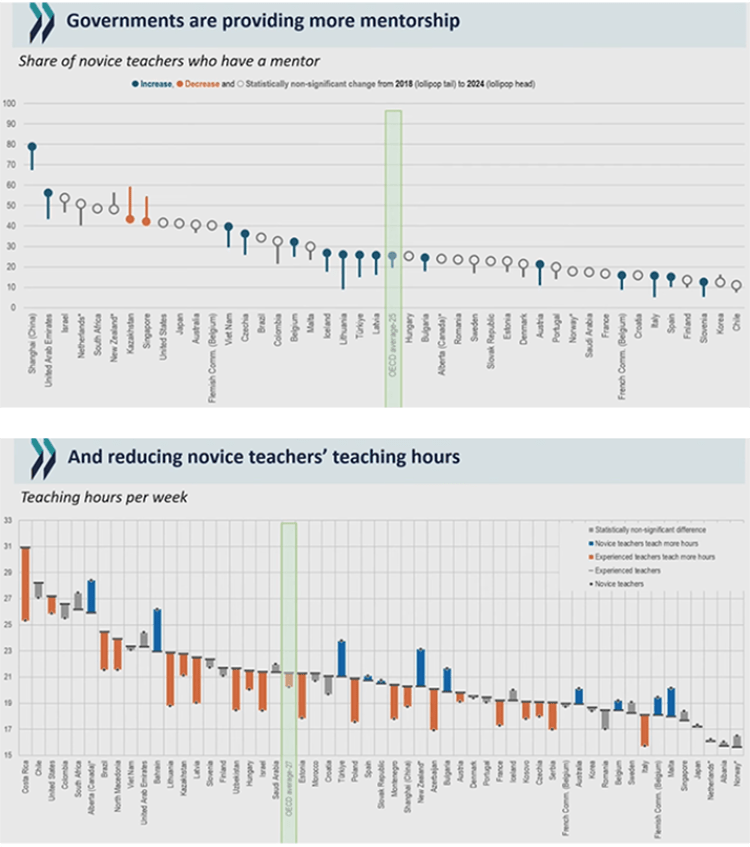
In response, governments are increasingly providing support for novice teachers through mentoring, which can greatly ease the transition from initial teacher education to actual classroom teaching. Most countries also reported their novice teachers are expected to teach fewer hours than experienced teachers, so they have time to engage with their mentors.
The 3 phases of Learning Forward’s mentor cycle
The worldwide increase in mentoring new teachers and in providing them with allocated time to acquire knowledge and develop new skills is a positive finding from the TALIS 2024 survey. New teacher mentoring is a solid strategy to boost teacher retention.
Learning Forward shaped its mentoring approach around a cycle of inquiry and support focused on diagnosing new teacher needs, providing coaching support to address those needs, and monitoring progress to measure growth and evaluate impact.
- Diagnose phase: This phase is the start of the mentor cycle. In this phase mentors are asking and then answering the question, “What does my mentee need?” They observe new teachers in their classrooms, analyze data on what they see and hear, and use evidence to set a learning goal with their mentees that will impact their teaching practice and their students’ learning.
- Coach phase: The coach phase of the cycle has mentors answering the question, “How am I going to support my mentee?” In this phase mentors select from various types of support, from providing resources to classroom support through modeling or co-teaching. This phase also includes debriefing during and following the provided supports.
- Monitor progress phase: During this phase mentors look at data from the support they’ve been providing to evaluate the impact of that work and determine the next steps for the new teacher. The mentor plans for and facilitates reflection conversations to develop the mentee’s capacity for self-analysis and to become a reflective practitioner committed to his or her own continuous improvement.
Learning Forward’s mentoring approach is qualitatively different from the traditional “buddy system” approach to mentoring. It instead establishes mentoring as high-quality professional learning for new teachers. When applying this approach in districts and systems, Learning Forward works alongside their leaders to tailor mentoring programs to their unique specifications, including budget and district goals.
New teachers are a bright spot in schools, bringing new energy, ideas, and commitment to the mission of student achievement with them every day. Large-scale benchmarking studies like TALIS provide useful insights and perspectives that education systems and policymakers can tap into to build strong support systems for all teachers, whether they are just starting out or are experienced teachers learning to be great mentors.
Resources
“Better than a buddy system: A framework for new teacher mentoring,” was published in the April 2025 The Learning Professional and excerpted and adapted from a soon-to-be-released book, Mentoring New Teachers: A Framework for Growth, by Leslie Ceballos, Thomas Manning, and Sharron Helmke.
OECD (2025), Results from TALIS 2024: The State of Teaching, TALIS, OECD Publishing, Paris, https://doi.org/10.1787/90df6235-en.